Last updated: October 8, 2026
Bed Rails, Bed Canes, and Getting Out of Bed Safely

Tyler Pahl, DPT — Educational Content
For an older adult, getting out of bed can be the hardest move of the day. You're stiff, maybe groggy, and going from lying flat to standing in seconds.
Many families buy a bed rail or bed cane to help. Used well, they can. Used wrong, they can cause the injury you were trying to prevent.
Why getting out of bed is risky
- Blood pressure drops. Going from lying to sitting to standing can drop blood pressure and cause dizziness (postural hypotension). The CDC notes symptoms are more likely in the morning, when blood pressure is naturally lower, and after long bed rest.
- Stiffness and grogginess. Rising from a soft, low mattress takes strength and balance, and half-awake people grab whatever is close.
- Urgency. A rushed trip to the bathroom is a big one. See The 2 a.m. Bathroom Trip: Making the Bed-to-Toilet Route Safer for the rest of that route.
The options
The FDA notes these products go by many names: side rails, half rails, bed handles, bed canes, assist bars, and more.
- Full-length rails. Run most of the bed's length, mainly to keep someone from rolling out. The catch: to get out, the person has to lower the rail or go over it.
- Half rails. Cover part of the bed, usually near the head. They give a handhold for rolling and sitting up, and leave an open way to get out.
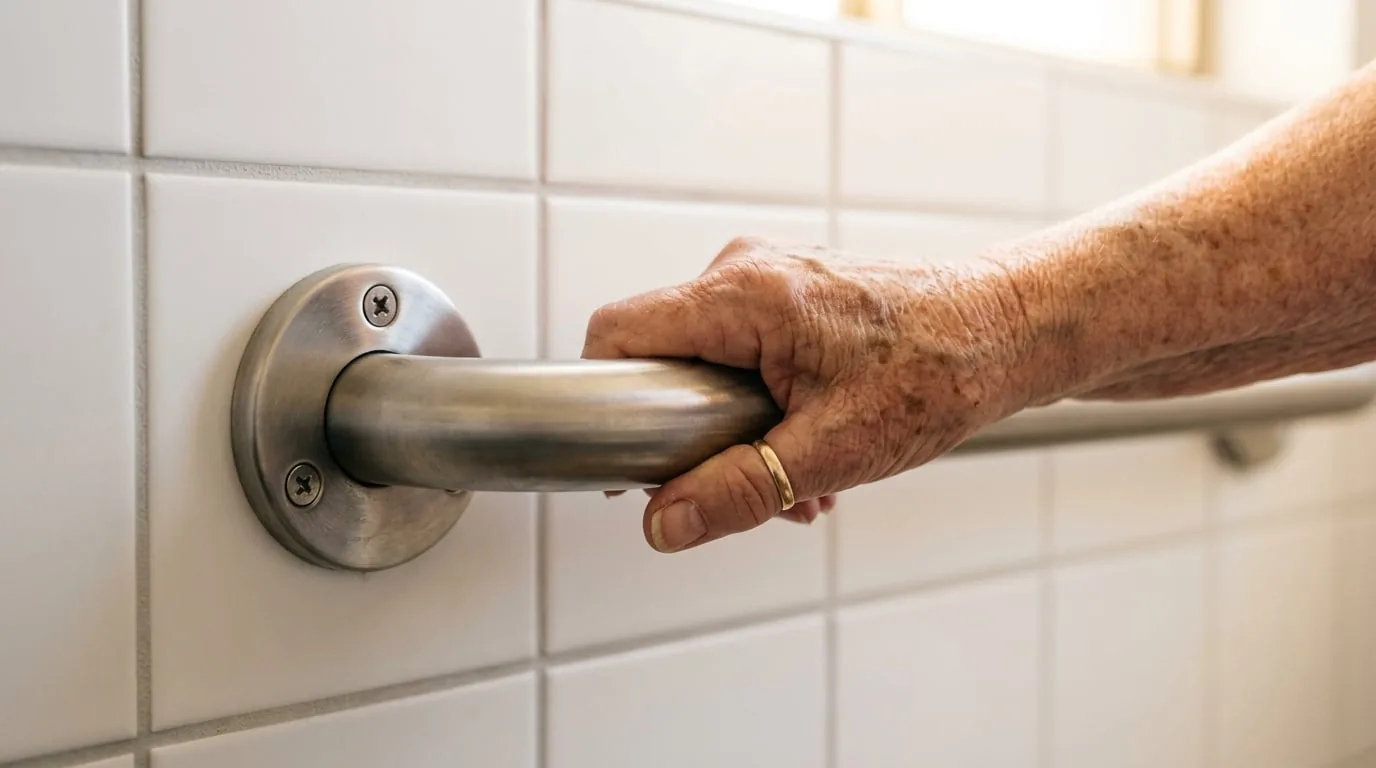
- Bed-assist handles (bed canes). A short handle, usually held by a frame under the mattress and a strap. It's for sitting up and standing, not keeping someone in bed.
- Floor-to-ceiling poles. Held by tension between floor and ceiling, beside the bed rather than on it. Follow the maker's rules on ceiling type and check that it stays tight.
- Adjustable-bed versions. If the bed's head or foot raises, buy a rail or handle made for that bed. The FDA notes bed position can create new gaps. Hospital beds come with their own rails.
If your parent just needs help getting up, a handle or pole is often a better fit than a long rail. The FDA's bed safety guide notes most people can be in bed safely without bed rails.
Safety first: entrapment and when a rail is wrong
The biggest danger with bed rails is entrapment: a person's head, neck, or body gets caught in a gap between the rail and mattress, within the rail, or under the end of the rail. This can cause suffocation or death. The CPSC identified 284 entrapment deaths involving adult portable bed rails from 2003 to 2021.
Adult portable bed rails made after August 21, 2023, must meet a federal CPSC standard (16 CFR part 1270) based on ASTM F3186-17. It covers rails, grab bars, assist bars, transfer aids, and canes. Older or used rails may not meet it, and CPSC testing before the rule found many rails didn't. The FDA also advises checking for ASTM F3186-17.
A rail may be the wrong choice if your parent:
- Has confusion, dementia, or memory problems
- Is restless or moves a lot in their sleep
- Has tried to climb over a rail, or might
- Has Parkinson's, stroke, MS, a balance disorder, or low blood pressure
The FDA lists these as higher-risk groups, warns that climbing over rails can lead to worse falls, and says a rail is no substitute for checking on someone.
FDA-listed alternatives include lowering the bed close to the floor, roll guards or foam bumpers, a concave mattress to reduce rolling off, and a bed trapeze for repositioning and getting in and out.
Fit checklist
Before your parent uses a rail or handle:
- It meets ASTM F3186-17 (check the label, box, or maker)
- The maker says it fits this bed, mattress, and mattress thickness
- The person's size and weight are within the maker's limits
- It's installed exactly as directed, with the safety strap fastened to the bed frame
- No gap wide enough to trap a head or body between rail and mattress
- The mattress edge is firm, and no soft topper or air mattress has changed the fit
- It doesn't shift when you push and pull on it
- You re-check it often, since rails can loosen and mattresses compress over time
When in doubt, the FDA says to call the maker.
Getting up: sit, pause, then stand
This is general education, not a treatment plan. A PT or OT can teach the method that fits your parent.
Lying to sitting
- Bend your knees and roll onto your side, facing the edge.
- Let the legs slide off the edge of the bed.
- Push up with your arms (using the handle if you have one) to sit up.
Pause. Sit with feet flat on the floor. Pump your ankles and open and close your hands for a few breaths, as the CDC suggests.
Sitting to standing
- Scoot forward to the edge of the bed.
- Set your feet flat, about hip-width apart, slightly behind your knees.
- Hands on the bed or a sturdy handle.
- Lean forward, "nose over toes."
- Push up through your legs and hands to stand.
- Stand still and tall for a moment before walking. If you feel dizzy, sit back down.
Bed height matters here. Sitting on the edge, feet should rest flat with knees about level with hips.
Pair it with light, a clear path, and good footwear
A handle helps with the first few seconds. The rest of the trip needs help too:
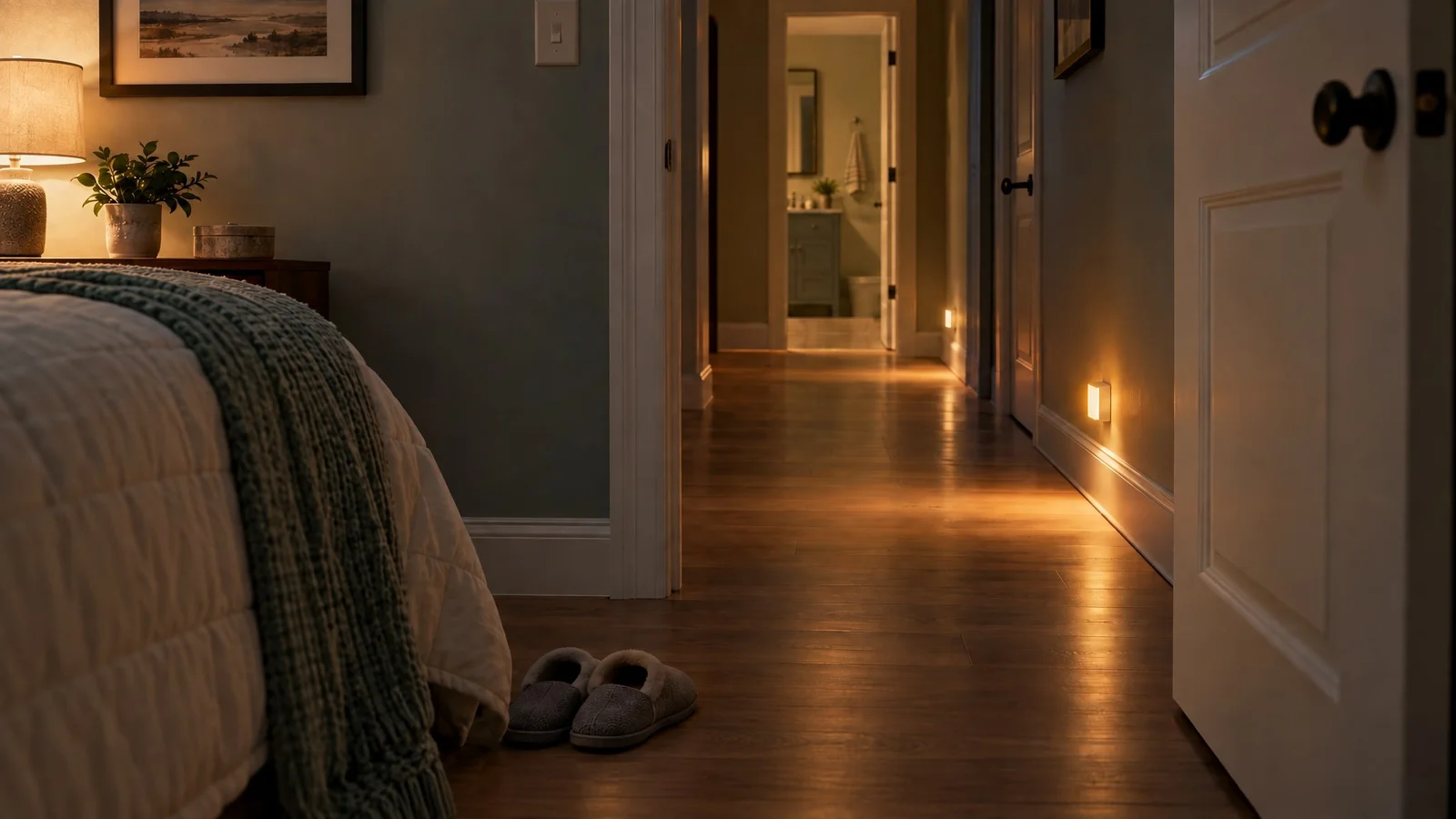
- Light. NIA suggests night lights and light switches close to the bed, plus a flashlight by the bed.
- A clear path. No rugs, cords, or clutter between the bed and the bathroom.
- Footwear. NIA recommends nonskid, rubber-soled, low-heeled shoes and warns against socks or smooth-soled slippers. Keep closed-back, non-slip slippers right where the feet land.
- A phone. NIA suggests a charged phone near the bed.
The 2 a.m. guide covers these in more detail.
When to ask a clinician
Talk with your parent's doctor, and ask about a PT or OT, if your parent:
- Has fallen or nearly fallen getting out of bed
- Gets dizzy when sitting or standing up
- Needs help, or several tries, to get up
- Is coming home after a hospital stay or surgery
A PT can work on strength, balance, and safe ways to get up. An OT can help choose and set up bed equipment. Before using a rail with someone who has confusion, ask the health care team first, as the FDA advises.
Quick checklist
- Picked the simplest tool that works (a handle or pole may be enough)
- Ruled out a rail if there's confusion, restlessness, or climbing
- Meets ASTM F3186-17, fits this bed, strap fastened, no gaps
- Re-checked often for loosening and new gaps
- Bed height lets feet rest flat
- Sit, pause, then stand, practiced during the day
- Light, clear path, non-slip slippers, and a phone by the bed
Start with the free 2-page home safety checklist for the rest of the house. For the full picture, the $49 House & Care Kit includes the 18-page Home Safety Checklist, the Caregiver Starter Kit, and the Doctor Visit Binder, so you can walk the house, organize what you see, and take it to the doctor.
Sources
- U.S. Food and Drug Administration. Adult Portable Bed Rail Safety. https://www.fda.gov/medical-devices/consumer-products/adult-portable-bed-rail-safety
- U.S. Food and Drug Administration. Recommendations for Consumers and Caregivers about Adult Portable Bed Rails. https://www.fda.gov/medical-devices/adult-portable-bed-rail-safety/recommendations-consumers-and-caregivers-about-adult-portable-bed-rails
- U.S. Food and Drug Administration, Hospital Bed Safety Workgroup. A Guide to Bed Safety Bed Rails in Hospitals, Nursing Homes and Home Health Care: The Facts. Revised 2010. https://www.fda.gov/medical-devices/hospital-beds/guide-bed-safety-bed-rails-hospitals-nursing-homes-and-home-health-care-facts
- U.S. Consumer Product Safety Commission. CPSC Issues New Federal Mandatory Safety Standard for Adult Portable Bed Rails. July 6, 2023. https://www.cpsc.gov/Newsroom/News-Releases/2023/CPSC-Issues-New-Federal-Mandatory-Safety-Standard-for-Adult-Portable-Bed-Rails
- U.S. Consumer Product Safety Commission. Adult Portable Bed Rails (Business Guidance). https://www.cpsc.gov/Business--Manufacturing/Business-Education/Business-Guidance/Adult-Portable-Bed-Rails
- Centers for Disease Control and Prevention, STEADI. Postural Hypotension: What It Is & How to Manage It. 2017. https://www.cdc.gov/steadi/pdf/steadi-brochure-postural-hypotension-508.pdf
- National Institute on Aging. Preventing Falls at Home: Room by Room. https://www.nia.nih.gov/health/falls-and-falls-prevention/preventing-falls-home-room-room
- National Institute on Aging. Falls and Fractures in Older Adults: Causes and Prevention. https://www.nia.nih.gov/health/falls-and-falls-prevention/falls-and-fractures-older-adults-causes-and-prevention
This article is for learning purposes only. It is not medical advice, diagnosis, treatment, or physical therapy, and reading it does not create a therapist–patient relationship. Your Home Health PT does not provide services or home evaluations. Always talk with your own doctor or licensed health care provider before making changes to medicines, exercise, or medical equipment, including bed rails. Follow the manufacturer's instructions for any product. If someone has fallen and is hurt, call 911.
This is educational material from Tyler A. Pahl, DPT (Nebraska License #4316). It is not a home evaluation or physical therapy treatment. Share it with your own provider.
Need a house plan, not just an article?
Download the free 2-page checklist, or get the House & Care Kit ($49) for the full 18-page walkthrough, caregiver pages, and doctor visit binder.
Dr. Tyler A. Pahl, DPT, Doctor of Physical Therapy obtained from Briar Cliff University with four years of Medicare home health clinical experience. He also holds an Honor's Bachelor of Science degree in Medical Biology with a minor in Psychology and Interdisciplinary Sciences from the University of South Dakota.
This content is for educational purposes only. Always consult with your healthcare provider before starting or changing any exercise program.