Last updated: October 7, 2026
Grab Bars vs. Towel Bars: What Actually Keeps You Safe
Educational Disclaimer: This content is for learning purposes only. It is not medical advice or physical therapy treatment. Always talk to your doctor or a licensed physical therapist before making changes to your home or exercise routine.
Tyler Pahl, DPT — Educational Content
It happens fast. You’re stepping out of the shower, your foot slides, and you grab the nearest thing on the wall. If that thing is a towel bar, there’s a good chance it bends, pulls out of the drywall, or snaps—and you go down harder than if you’d grabbed nothing at all.
This isn’t a scare tactic. It’s physics. Towel bars and grab bars look similar, but they are completely different devices built for completely different jobs. Understanding that difference could prevent the most common type of in-home fall for older adults.
The Numbers Behind Bathroom Falls
The CDC reports that about 235,000 Americans visit the emergency department each year for bathroom injuries. Falls cause 81% of them. Two-thirds of those falls happen in or near the shower or bathtub—exactly where towel bars are typically mounted.
Among adults 65 and older, 30% of bathroom fall injuries result in fractures. A hip fracture alone can cost $30,000–$40,000 in hospital and rehab expenses, and roughly one in five hip fracture patients never returns to their previous level of independence.
The irony: many of these falls happen because the person reached for something that looked like support but wasn’t.
How a Towel Bar Is Built (and Why It Fails)
A towel bar is a decorative fixture. Its job is to hold a damp towel that weighs about one pound. Here’s what’s typically inside one:
- Hollow tubing—usually thin-gauge aluminum, zinc alloy, or chromed plastic
- Small mounting brackets attached to the wall with short screws, often directly into drywall
- No structural reinforcement—the bar is designed to look clean on the wall, not resist force
When a 150-pound person grabs a towel bar during a slip, the force isn’t just 150 pounds. A sudden grab adds dynamic load—your body’s momentum, the angle of your grip, the jolt of deceleration. That can multiply the effective force to 200, 300, even 400 pounds in an instant. The towel bar’s mounting hardware was never designed for anything close to that.
The result: the bracket tears out of the drywall, the bar bends or breaks, and the person falls—often more violently because their body was mid-recovery when the support vanished.
How a Grab Bar Is Built (and Why It Holds)
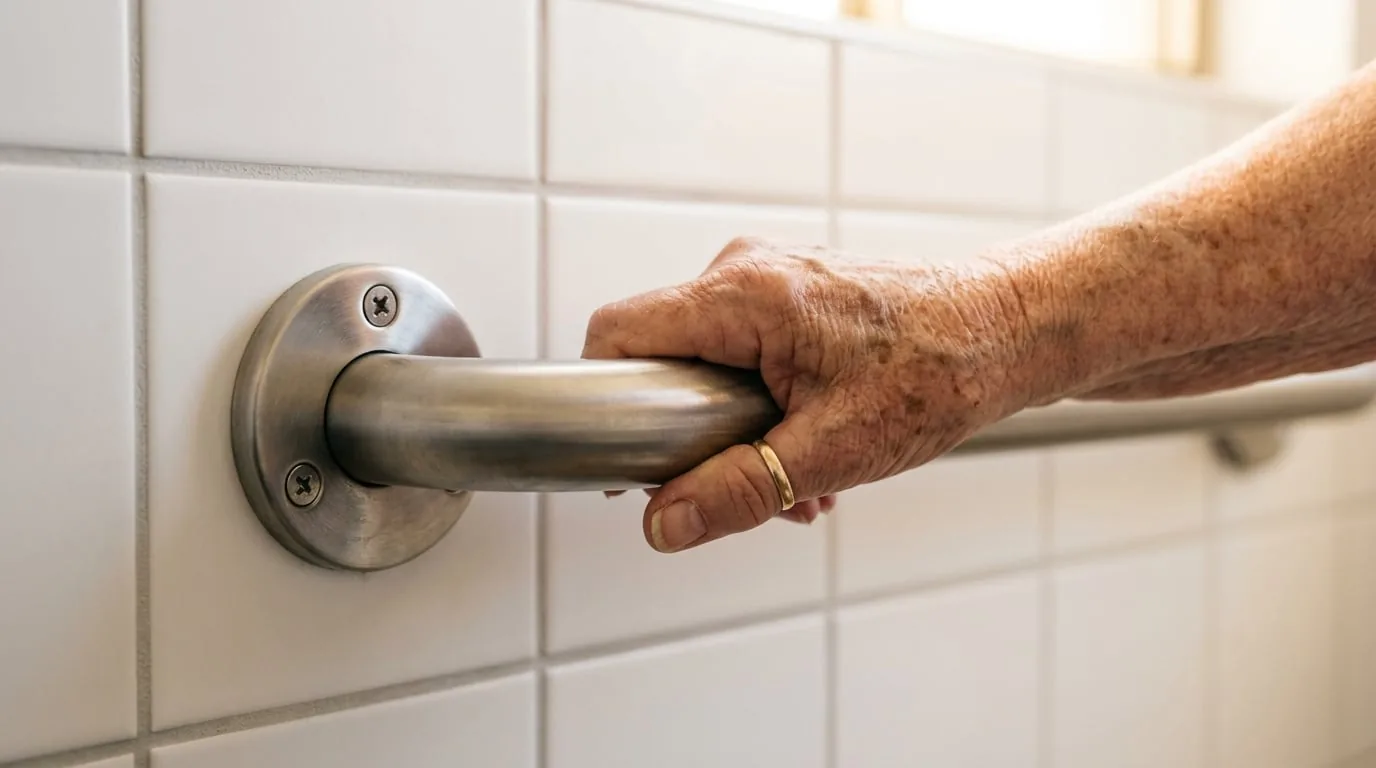
A grab bar is a safety device engineered to bear human body weight. The differences are fundamental:
| Feature | Towel Bar | Grab Bar |
|---|---|---|
| Weight capacity | 1–5 lbs (a towel) | 250–500 lbs (ADA minimum: 250 lbs) |
| Material | Hollow tubing, plastic, thin alloy | Solid stainless steel or heavy-gauge tubing |
| Mounting | Drywall anchors or short screws | Lag bolts into wall studs or wood blocking |
| Grip surface | Smooth chrome or brushed nickel | Textured, peened, or vinyl-coated for wet-hand grip |
| Diameter | Varies widely (often thin) | 1.25–2 inches (ADA spec for secure grip) |
| Wall clearance | Flush or close to wall | 1.5 inches minimum (room for fingers to wrap around) |
Research backs this up. A RESNA study found that seniors with properly installed grab bars were 75% more likely to regain their balance during a slip near the bathtub. The key phrase is “properly installed”—a grab bar that’s not anchored into studs is no better than a towel bar.
The Suction-Cup Myth
Suction-cup grab bars are sold in pharmacies and marketed as a quick fix. Some claim to hold 200–300 pounds. But those ratings reflect static load under perfect conditions—a slow, even push on a perfectly smooth, clean surface.
In real life, a slip involves sudden, uneven force on a surface that may have soap residue, textured tile, or moisture behind the cup. Testing shows suction bars can fail under as little as 75–100 pounds of sudden force. They should be used only for temporary travel, never as a permanent safety fixture.
Where Grab Bars Should Go (and Why Placement Matters)
It’s not enough to have a grab bar somewhere in the bathroom. Research on grab bar configuration shows that placement affects whether the bar actually helps or creates a false sense of security. A bar on the wrong wall can force you to reach across your body or twist—both of which can increase fall risk instead of reducing it.
By the Toilet
- Side wall: A 42-inch horizontal bar, starting no more than 12 inches from the rear wall, mounted 33–36 inches above the floor. This gives you something to push off when standing.
- Rear wall: A 36-inch bar centered behind the toilet. Useful for steadying yourself while sitting down.
- Alternative: If wall space is tight, a toilet safety frame that clamps onto the toilet base gives you padded armrests on both sides.
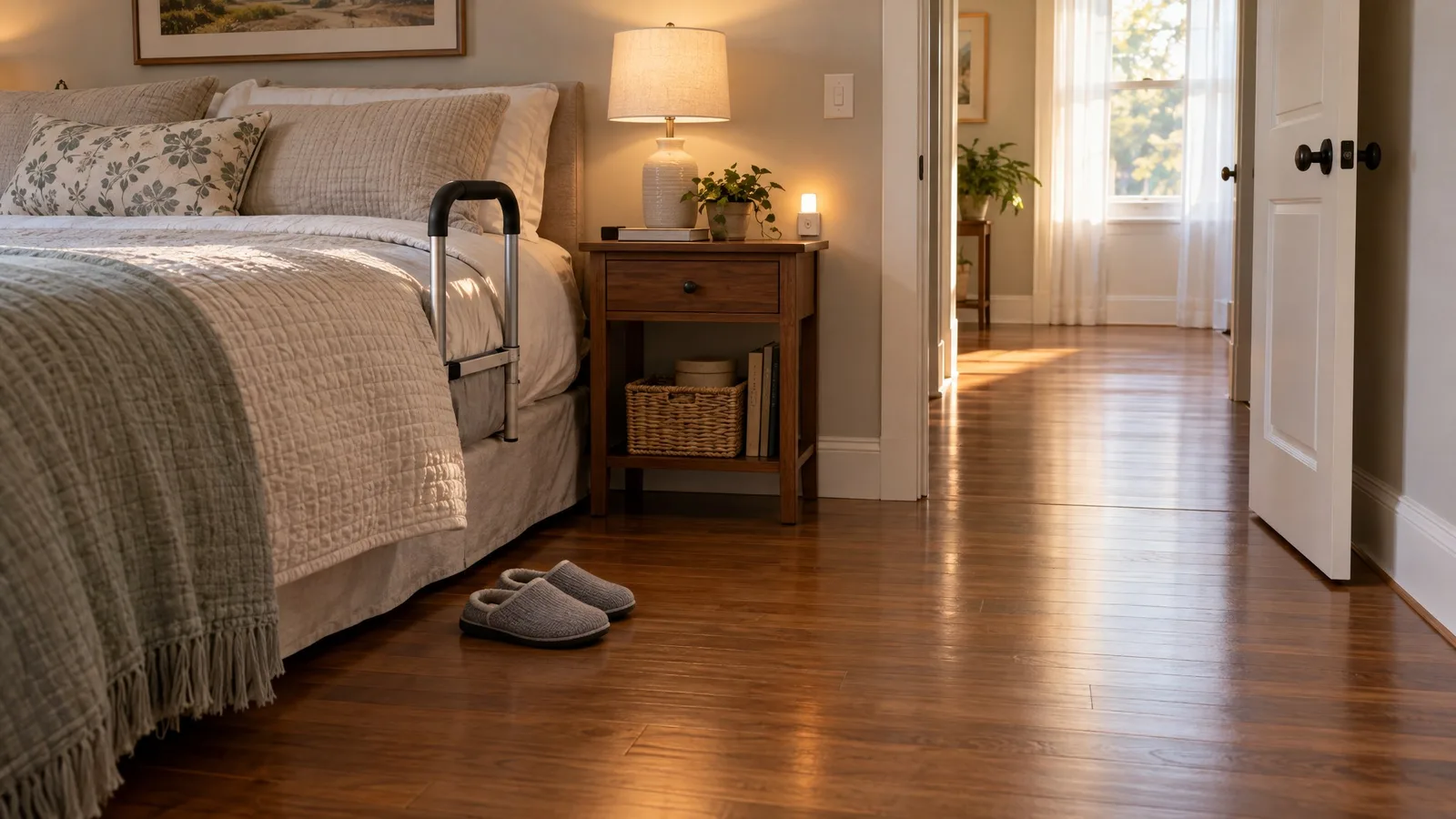
Night trips to the toilet are when people grab the nearest thing. See The 2 a.m. Bathroom Trip: Making the Bed-to-Toilet Route Safer for the rest of the route, from getting out of bed to lighting the hallway.
In the Shower or Tub
- Entry bar (vertical): An 18–24 inch vertical bar at the shower entrance, where you step over the threshold. This is the moment when you’re shifting your weight on one foot on a wet surface.
- Long wall (horizontal): A 24–36 inch bar at waist height on the longest shower wall, for balance while standing or reaching.
- Back wall of tub: A 24-inch horizontal bar above the tub rim for getting in and out.
The Most Common Mistake
The single most common mistake is mounting a grab bar into drywall without hitting a stud. Drywall can hold about 15–20 pounds of force before a standard anchor pulls through. A grab bar needs to hold 250+ pounds. If there’s no stud where you need the bar, a contractor can install wood blocking behind the drywall—a reinforced plate that distributes the load across the wall frame.
Other Things That Look Like Support but Aren’t
Towel bars aren’t the only fixtures people grab in a moment of panic. None of these are rated for body weight:
- Toilet paper holders—typically held by two small screws
- Sink edges—pedestal sinks can tip; vanity-mounted sinks may pull away from the wall
- Glass shower doors—the door frame can bend or the glass can shatter under sudden lateral force
- Shower caddies and shelving—tension-mounted rods will slide and collapse
If you can’t pull it with your full body weight without it breaking, it’s not a grab bar. It’s a decoration that happens to be within reach.
Modern Grab Bars Don’t Look “Institutional” Anymore
One reason people resist grab bars is the look. The old chrome hospital bars sent a message nobody wanted in their home. But grab bar design has changed dramatically. Today you can find bars that:
- Match your existing bathroom hardware (matte black, brushed nickel, oil-rubbed bronze)
- Double as a towel bar with a grab-bar core—same ADA weight rating, towel-bar appearance
- Include built-in shelving for soap or shampoo
- Come in decorative angular or curved shapes that blend with modern tile work
The safety is identical. The stigma is gone. A good contractor or aging-in-place specialist can help you choose hardware that matches your bathroom’s style.
What It Costs (and Who Can Help in Nebraska)
A quality ADA-rated grab bar costs $15–$50 at most hardware stores. Professional installation typically runs $100–$200 per bar, including finding studs, drilling, and sealing around the mounting points. That means a three-bar bathroom setup—shower entry, shower wall, and toilet—often costs under $500 total.
Compare that to the cost of a single fall: a hip fracture averages $30,000–$40,000 in medical costs, and one in five patients never return to their previous independence.
If cost is a barrier, Nebraska residents have several options:
- Aging Partners Home Handyman in Lincoln can install grab bars on a sliding-scale fee for adults 60+: (402) 441-7030
- Nebraska Medicaid Aged & Disabled Waiver covers grab bars and other modifications for qualifying adults: (402) 471-3121
- League of Human Dignity offers Barrier Removal Grants: (402) 441-7871
For a complete list of Lincoln-area contractors and funding programs, visit our Home Safety & Aging-in-Place Modifications resource page.
The Bottom Line
A towel bar and a grab bar may look similar on a wall. But one is designed to hold a towel. The other is designed to hold you.
If you or someone you care for lives alone, has had a near-miss in the bathroom, or simply doesn’t feel as steady as they used to, this is one of the highest-impact safety changes you can make. It’s not expensive. It’s not complicated. And the research is clear: it works.
Ready to check your bathroom? Our free Home Safety Checklist includes a detailed bathroom safety section. For the full room-by-room guide with action plans and cost estimates, see our Comprehensive 18-Page Home Safety Checklist.
Want to go deeper into making every zone of your bathroom safer? Read our full Bathroom Safety for Seniors guide for zone-by-zone modifications backed by research.
One simple test: Walk into your bathroom right now and look at every bar, rail, and handle within arm’s reach. Ask yourself: “If I slipped and grabbed this with my full weight, would it hold?” If the answer is no—or even maybe—it’s time to install a real grab bar. It’s one of the easiest and most effective ways to stay safe at home.
Sources
- Centers for Disease Control and Prevention. Nonfatal Bathroom Injuries Among Persons Aged ≥15 Years. MMWR, 2011.
- RESNA. Use of Bathroom Grab Bars by Community-Living Older Adults. 2016.
- ADA Standards for Accessible Design. Section 609: Grab Bars.
- Washington University School of Medicine. Fall Prevention Program Reduces In-Home Falls by Nearly 40%.
This article is for learning purposes only. It is not physical therapy treatment or medical advice. Always talk to your doctor or a licensed physical therapist before making changes to your home or exercise routine.
Need a house plan, not just an article?
Download the free 2-page checklist, or get the House & Care Kit ($49) for the full 18-page walkthrough, caregiver pages, and doctor visit binder.
This is educational material from Tyler A. Pahl, DPT. It is not a home evaluation or physical therapy treatment. Share it with your own provider.
Dr. Tyler A. Pahl, DPT, Doctor of Physical Therapy obtained from Briar Cliff University with four years of Medicare home health clinical experience. He also holds an Honor's Bachelor of Science degree in Medical Biology with a minor in Psychology and Interdisciplinary Sciences from the University of South Dakota.
This content is for educational purposes only. Always consult with your healthcare provider before starting or changing any exercise program.