Last updated: August 12, 2026
Bathroom Safety for Seniors: An Evidence-Based, Room-by-Room Guide
Educational Disclaimer: This content is for learning purposes only. It is not medical advice or physical therapy treatment. Always talk to your doctor or a licensed physical therapist before making changes to your home or exercise routine.
Tyler Pahl, DPT — Educational Content
If someone asked you to name the most dangerous room in a senior’s home, you might guess the stairs or the kitchen. But research tells a different story. According to the Centers for Disease Control and Prevention (CDC), roughly 235,000 Americans visit the emergency department each year for bathroom injuries—and falls cause about 81% of them. For adults 65 and older, those falls lead to fractures about 30% of the time.
The good news: most bathroom falls are preventable. A landmark study from Washington University School of Medicine found that personalized home modifications—led by occupational therapists—reduced in-home falls by nearly 40%. And every $1 spent on those modifications saved roughly $2 in medical costs.
This guide walks through the bathroom zone by zone, pairing each hazard with the evidence-based fix that research supports most.
Why the Bathroom Is Uniquely Dangerous
Three factors collide in the bathroom that don’t occur together anywhere else in the home:
- Wet, slippery surfaces on floors, tub bottoms, and shower tiles
- Complex transfers—stepping over a tub wall, lowering onto a toilet, twisting to reach faucets
- Tight spaces that leave little room to recover if balance shifts
The CDC data shows two-thirds of bathroom injuries happen in or near the tub or shower. Toilet-related injuries account for about 14% overall—but that number jumps to 37% for adults 85 and older. Late-night bathroom trips add low lighting and grogginess to the mix.
Zone 1: The Shower and Bathtub
This is the highest-risk area in the bathroom. Getting in and out of a traditional tub requires stepping over a 14–16 inch wall while shifting your center of gravity on a wet surface. Research identifies several modifications that make a measurable difference:
Grab Bars (The Single Most Important Modification)
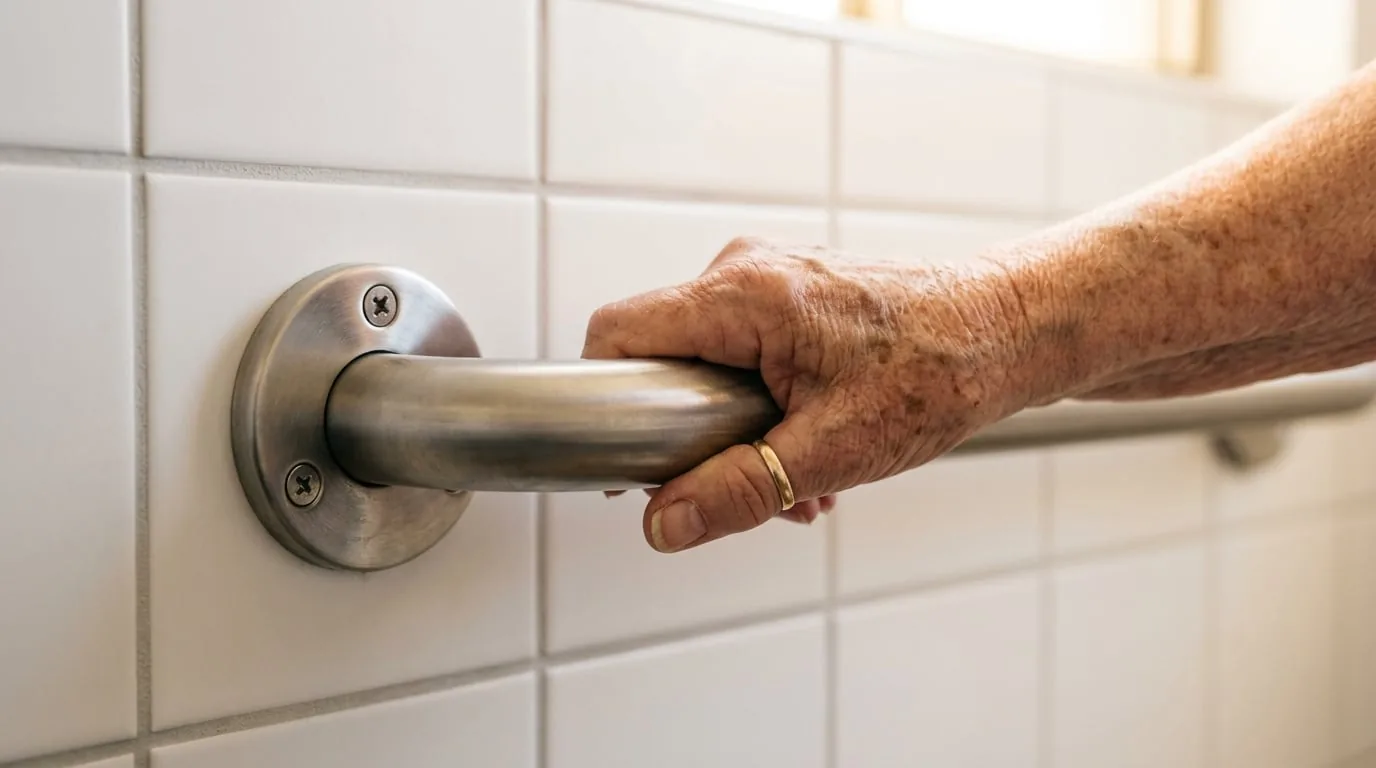
Properly installed grab bars are the most frequently recommended bathroom safety feature in the research literature. A RESNA study found that seniors with access to grab bars are 75% more likely to recover their balance during a slip near the bathtub compared to those without. But not all grab bars are created equal—learn the critical differences in our guide to grab bars vs. towel bars.
Key specifications from the ADA Standards:
- Must support at least 250 pounds of force
- Diameter between 1.25 and 2 inches for a secure grip
- Mounted 33–36 inches above the floor
- At least 1.5 inches of clearance between bar and wall
- Anchored into wall studs or reinforced blocking—never into drywall alone
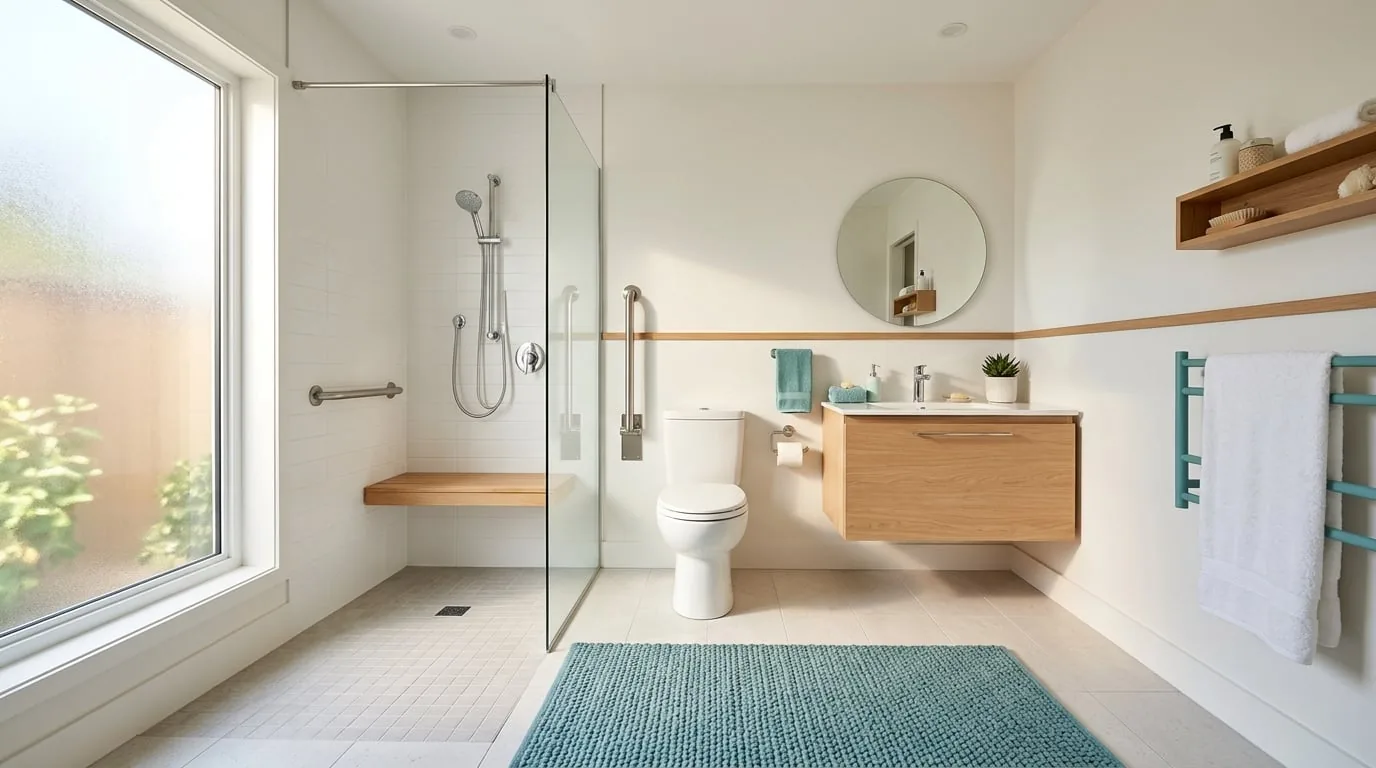
Place one vertical bar at the shower entrance for stepping in and out, and one horizontal bar on the long wall at waist height for balance while standing. If you use a bathtub, add a bar on the back wall above the tub rim.
Important note: Suction-cup grab bars are not a safe substitute. While manufacturers may claim high weight ratings, real-world testing shows they can fail under as little as 75–100 pounds of sudden force. They’re acceptable only for short-term travel use.
Shower Seating
A sturdy shower bench or built-in seat eliminates the need to stand throughout the entire shower. The American Occupational Therapy Association (AOTA) recommends slip-resistant, self-draining seats that can hold at least 300 pounds. This is especially important for anyone who feels unsteady standing on wet surfaces or who has had a recent surgery, stroke, or prolonged illness.
Low-Threshold or Curbless Showers
Replacing a traditional tub with a low-threshold or curbless walk-in shower removes the single biggest tripping hazard in the bathroom. Research consistently identifies the tub wall step-over as a top cause of shower-related falls. If a full remodel isn’t in the budget, a tub transfer bench that extends over the tub rim lets you sit down outside the tub and slide in—no step-over required.
Handheld Showerhead
A flexible handheld showerhead on a slide bar lets you rinse while seated or standing without twisting or reaching overhead. The AOTA recommends a hose at least 60 inches long so you can direct water where you need it. This small swap—usually under $30—can eliminate a lot of risky reaching.
Zone 2: The Toilet Area
Standing up from a standard toilet (14–15 inches high) requires significant quad and hip strength. As strength declines with age, many seniors compensate by grabbing whatever is nearby—a towel bar, a sink edge, or a toilet paper holder. None of these are designed to bear weight, and all can give way without warning.
Raised Toilet Seat or Comfort-Height Toilet
Research supports raising the toilet seat height to 17–19 inches (called “comfort height”). This reduces the depth of the sit-to-stand movement, putting less demand on weak knees and hips. Options include:
- A clamp-on raised seat (adds 2–4 inches, about $25–40)
- A toilet base riser (“Toilevator”) that elevates the entire toilet
- A comfort-height replacement toilet (17–19 inches from floor to seat)
Toilet-Area Grab Bars
The ADA recommends a 42-inch side-wall bar (positioned no more than 12 inches from the rear wall) and a 36-inch rear-wall bar behind the toilet. In a home setting, even one well-placed side bar makes a significant difference. If wall space is limited, a toilet safety frame that bolts to the toilet itself provides padded armrests on both sides.
Zone 3: Flooring
Wet bathroom floors are a consistent finding in fall-injury research. Several evidence-supported strategies address this:
- Non-slip adhesive strips or mats inside the tub or shower (look for mats that suction firmly to the surface and have drainage holes)
- Slip-resistant floor treatment on existing tile—commercial anti-slip coatings can improve traction without replacing the floor
- Remove loose bath mats from outside the shower. If you use a mat, choose one with a heavy rubber backing that won’t slide or bunch
- Wipe up water promptly—even a few drops on smooth tile can cause a fall
Zone 4: Lighting
Poor lighting compounds every other bathroom hazard. Late-night bathroom trips are one of the most common fall scenarios because people navigate in near-darkness to avoid waking a partner. Evidence-based fixes:
- Motion-activated night lights along the path from bedroom to bathroom and inside the bathroom itself (about $10–15 for a multi-pack)
- Higher-wattage bulbs in existing fixtures—the bathroom should be one of the brightest rooms in the home
- Rocker-style light switches (large paddles you can hit with a palm or elbow) mounted 42–48 inches above the floor, as recommended by occupational therapy guidelines
Zone 5: Faucets, Doors, and Layout
A few smaller changes round out a safe bathroom:
- Lever-style faucet handles replace round knobs that require grip strength and twisting. Lever handles can be operated with a closed fist or the side of a hand—important for anyone with arthritis
- Shower curtains instead of glass doors where possible. Glass shower doors can block access to someone who has fallen inside the shower. A curtain can be pushed aside instantly
- Clear the clutter—remove unnecessary bottles, baskets, and storage from the floor. Keep daily-use items at counter height
- Anti-scald valve on the water heater (set to 120°F or lower) to prevent burns during a fall if hot water continues running
What the Research Says About Cost
Bathroom modifications range from nearly free to several thousand dollars, but the evidence strongly favors them as a smart investment:
- The Washington University study found an average intervention cost of $765 per person, resulting in an estimated $1,613 reduction in healthcare costs—more than double the return
- The CDC estimates that annual medical costs for fall injuries in the U.S. exceed $50 billion
- A single hip fracture can cost $30,000–$40,000 in hospital and rehabilitation expenses
Many of the most effective changes—non-slip mats, night lights, removing loose rugs—cost under $20. Even grab bar installation typically runs $100–$200 per bar, including hardware and labor.
Getting Help With the Cost in Nebraska
If cost is a concern, several programs serve Nebraska residents:
- Nebraska Medicaid Aged & Disabled Waiver can cover grab bars, roll-in showers, and ramps for qualifying adults: call (402) 471-3121
- City of Lincoln Housing Rehabilitation offers 0% interest loans for home modifications: call (402) 441-5668
- USDA Section 504 grants up to $10,000 for homeowners 62+ in rural areas: call (402) 437-5551
For a full list of Lincoln-area contractors and funding options, visit our Home Safety & Aging-in-Place Modifications resource page.
Start With a Professional Assessment
Every bathroom is different, and the best modifications depend on who uses the space and how they move. An occupational therapist (OT) can do a home safety assessment that identifies your specific risks and recommends changes tailored to your mobility, balance, and daily routine. Ask your doctor for a referral—Medicare Part B often covers the assessment when there’s a documented need.
Want to do a quick self-check first? Our free Home Safety Checklist walks you through every room, including a detailed bathroom section. And our Comprehensive 18-Page Home Safety Checklist goes even deeper with room-by-room action plans, cost estimates, and contractor guidance.
Key takeaway: The bathroom doesn’t have to be the most dangerous room in your home. Start with the highest-impact, lowest-cost changes—grab bars, non-slip mats, and better lighting—and build from there. The research is clear: these modifications work, and they pay for themselves many times over in falls prevented.
Sources
- Centers for Disease Control and Prevention. Nonfatal Bathroom Injuries Among Persons Aged ≥15 Years. MMWR, 2011.
- Washington University School of Medicine. Fall Prevention Program Reduces In-Home Falls by Nearly 40%.
- RESNA. Use of Bathroom Grab Bars by Community-Living Older Adults. 2016.
- ADA Standards for Accessible Design. Section 609: Grab Bars.
- American Occupational Therapy Association. Safe at Home. OT Practice, 2022.
This article is for learning purposes only. It is not physical therapy treatment or medical advice. Always talk to your doctor or a licensed physical therapist before making changes to your home or exercise routine.
Need a house plan, not just an article?
Download the free 2-page checklist, or get the House & Care Kit ($49) for the full 18-page walkthrough, caregiver pages, and doctor visit binder.
This is educational material from Tyler A. Pahl, DPT. It is not a home evaluation or physical therapy treatment. Share it with your own provider.
Dr. Tyler A. Pahl, DPT, Doctor of Physical Therapy obtained from Briar Cliff University with four years of Medicare home health clinical experience. He also holds an Honor's Bachelor of Science degree in Medical Biology with a minor in Psychology and Interdisciplinary Sciences from the University of South Dakota.
This content is for educational purposes only. Always consult with your healthcare provider before starting or changing any exercise program.